Reading material: you should have the paper(s) you got on the first day, and ones you found yourself, that describe your lab protein.
Goals: to start looking at the active sites of proteins, first the sample (cellulase) structure, then the protein that you downloaded in the "Protein structure/function 1" exercise (remember, this is a homologue of your wet lab protein, so very interesting to you!).
Enzyme catalysis depends critically on two things:
1. binding the right thing(s), and not the wrong ones
2. creating the right environment for the desired
reaction
In this exercise, we'll take a look at these two aspects of proteins (i.e. binding and catalysis). Even proteins that are not enzymes need to be able to recognise the molecules to which they bind, so that part is universal.
As you
work along today, please discuss questions Q1-3 with us, as well as
your thoughts on "your own" protein. You are not asked to hand
anything in, but we do want to know how you are thinking!
Step 1: The protein we will take as an example is a cellulase. Cellulases eat cellulose for breakfast, lunch and dinner. Enzymes like this are secreted by bacteria and fungi, and allow them to break down wood and other plant material. In fact, many animals, such as horses and cows, would be dead without symbiotic bacteria and fungi living in their gut. Cellulases are essential in solubilizing cellulose and so allowing recycling of the huge quantities of carbon that are bound up in it. To be able to do that, the cellulase must be able to bind to/recognize cellulose (and not, for example, cholesterol), and then to cut it up (by hydrolysis).
Download cellulase coordinates from the PDB (or PDBe) using entry code 1CEL (make sure you used the pdb format, not cif), and turn the second (B) molecule off (it is there for technical reasons to do with the crystallography; this enzyme is not a dimer).
Q1.
Where is the
active site? Given what you learned in the lecture today, you should
be able guess where the active site is. Show us, and explain your
reasoning! Look
at a surface representation of the protein Tools -> Compute Molecular
Surface. Now what do you see? There are a number of web-based tools for
identifying pockets or cavities in proteins. These can quickly give you
an idea of which part(s) of your structure to look closer at. One you
could try is CASTp.
We have noticed that there can be problems with this server. So, backups
might be at: http://voronoi.hanyang.ac.kr/betacavityweb/
and DoGSiteScorer.
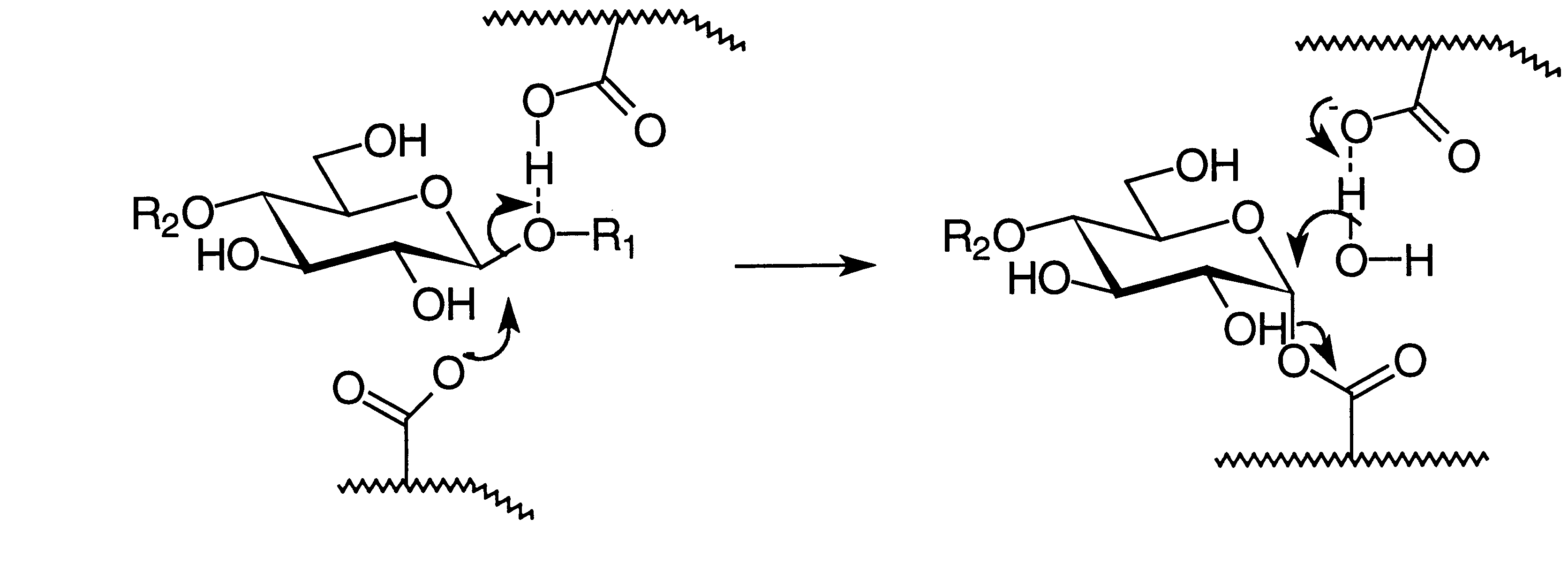
Q3. How does cellulase catalyze the hydrolytic reaction? The nucleophile that is used to attack cellulose is Glu212, and the acid/base involved in the reaction is Glu217. Looking at the 8CEL (or 4C4C or 4C4D) structure in Swiss-PDBViewer, arrange your view so that it looks like the picture below, and try to imagine what is happening in the active site during the cleavage (cutting) of cellulose. Glu212 carries the acid group at the bottom, and Glu217 is the one at the top.
You might also want to look at the movie that Wimal Ubhayasekera made. This shows how cellulose "slides" into the active site groove, how two glucose units are cut off as a disaccharide, and how the cellulose slides along again, and...
Step 2: Now, take a look at your own protein (the protein that you downloaded in the "Protein structure/function 1" exercise), and ask yourself how it binds the things it needs to bind, and carries out chemistry on them. Given the guidelines you got at the end of the "architecture" lecture, and the tools suggested above, could you find the active site?
=> Some questions to ask yourself:
What substrate does your enzyme bind? How does it bind to it, i.e. how
does the enzyme know what substrate it is?
What are the catalytic residues, and how do they catalyze the
reaction?
Do you have enough information yet to answer these questions right now? What would help you decide? Look in the paper you got the first day to get more ideas! What tools were used there?
